Move from spending on FTE to saving with routine automation with Flex Databases CTMS

November 30, 2022 - 1 min read
Clinical trials, as everything else in the world, is undergoing a heavy shift to process digitalization and automation. It has its ups and downs, but the future looks bright – we can minimize human error, optimize, and automate our processes and save money. Today we’ll talk about how exactly you can move from spending money on FTE to saving it with routine automation, brought to you by Flex Databases CTMS.
Here’s a graph from our Novo Nordisk case study:
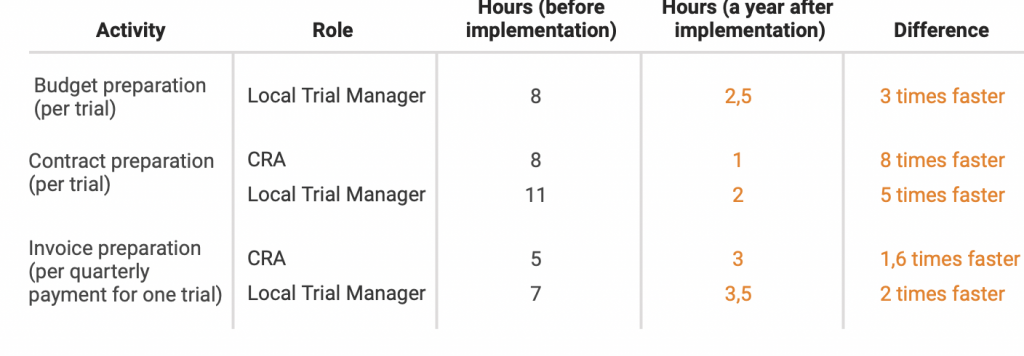
Let’s imagine, that our Local Trial Manager prepares 1 budget, 1 contract and 1 set of invoices per month to make our calculations simple.
Before CTMS implementation it would take them 8 + 11 + 7 = 26 hours in total
After CTMS implementation it would take them 2,5 + 2 + 3,5 = 8 hours in total
After CTMS implementation we’re saving 18 hours per month on budget & invoice management only.
Now we talk money. Salary.com provides us with $131,009 average annual salary for a Local Trial Manager in the US. With an 8 hour long workday, even without holidays is will bring us to the following rates:
Annual: $131,009
Monthly: $10,917
Hourly: $65
If we save 18 hours per month, it means that for an average Local Trial Manager we save $1170. ONLY on budget & invoice management. $14,035 per year.
Imagine, if we had two managers as an example for this calculation. Think about how many you have.
Digitalization is usually promoted as cost-effective – and here’s our take on that
More From the Blog

September 29, 2026
EDC Data Solution Specialist (Data Manager)
Learn more→

September 24, 2026
How ITS Achieved 98% TMF Completeness and Cut Audit Prep Time in Half
Learn more→

September 14, 2026
Flex Databases Product Updates: EDC, IWRS & eCRF Builder Updates That Remove Manual Work From Study Teams
Learn more→
Talk to us. See it yourself
Skip the generic demo. A specialist who works with this platform every day will walk you through it live, answer the hard questions directly, and show you exactly how it would run in your organization — not a script, not a slide deck.